Warning: contains plot spoilers for Disclosure Day
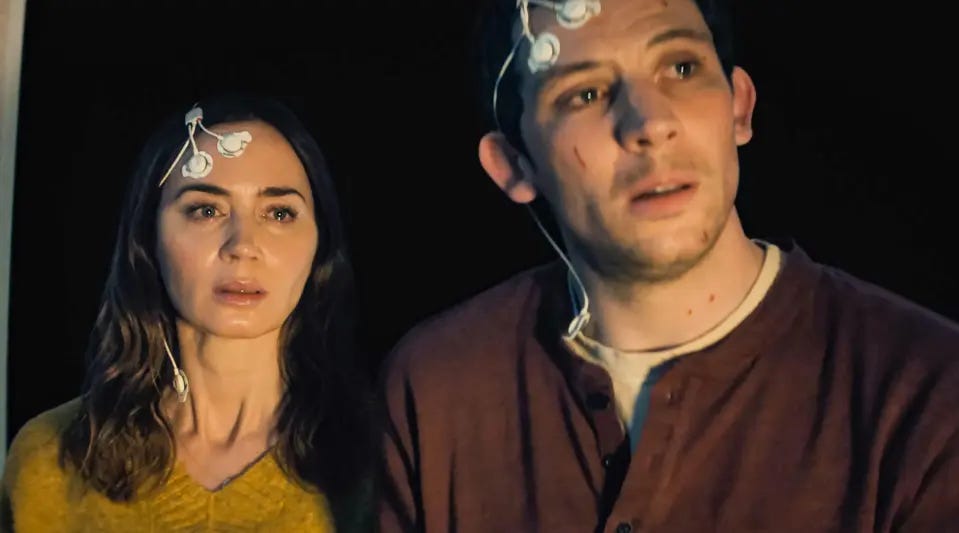
I loved Spielberg’s latest film, Disclosure Day, starring Emily Blunt, Colin Firth and Josh O’ Connor. It was a feast for the imagination, fast-paced and it contained all the usual sentimental escapism I’ve always loved Spielberg for.
It felt like the final instalment in Spielberg’s lifelong fascination with alien-encounter stories. From Close Encounters of a Third Kind to E.T., Indiana Jones and the Kingdom of the Crystal Skull, War of the Worlds and Super 8 (as Producer) to name a few, Spielberg has always loved this concept.
My own hunch is that interest in aliens fills the space occupied by God in earlier ages—a longing that, and I am only speculating here, a secular Jew such as Spielberg may sense but struggle to satisfy after the horrors of the Holocaust. That’s a blind theory but it might well fit the director who also gave us Schindler’s List.
Disclosure Day felt like the closing of the loop on the theme, Spielberg finally allowing himself the satisfaction of telling a story in which the government’s attempts to keep the truth hidden is defeated.
There was much to enjoy about the film, but also a few things to reflect on.
The Wisdom of Partnership (humanity)
“There was always two of you!” Hugo Wakefield (Colman Domingo) says after discovering that Daniel Kellner (Josh O’Connor) isn’t the only ‘passenger’ for the aliens. Margaret Fairchild (Emily Blunt) and Kellner must then locate one another and team up in order for the title’s disclosure day to take place.
It was great to witness a strong partnership between a man and a woman that wasn’t romantic and also, didn’t try to subvert gender norms. They felt like real characters in that respect rather than the agenda-driven tropes of political signalling we’ve sadly become too used to in recent years.
More than simply portraying a healthy friendship, it was refreshing to see a male-female partnership that wasn't competitive but instead celebrated the wisdom of God in creation.
In one scene Fairchild rescues Kellner, in another he rescues her. He’s free to play to his strengths and she to hers, both are celebrated and both are essential in the story. Even at the end, in a moment that felt ever so slightly like it was tipping its hat to Eden, the alien (the supreme being/god in the story) whispers the message for the world first to Kellner who must then repeat it for Fairchild to deliver. As Adam did in the garden with Eve, as Christ (the second Adam) did in the Easter garden to Mary so the film does here. For the sake of the world a man and woman must co-operate in a partnership of mutual honour.
The Enchantment of Nature (creation)
“They often appear as animals so as not to scare us.” Hugo Wakefield
Animals play an important role in the film. As well as taking the form of animals for the reason quoted above, both Fairchild and Kellner experienced a calling from the aliens in the form of a red cardinal (a bird) when they were children. When animals appear in the film they often seem to be trying to communicate with the characters, and both Fairchild and Kellner seem to be able to sense their emotional state.
A herd of deer appears at a patio window staring into the eyes of Kellner, willing themselves to be understood by him and a tame fox approaches Fairchild trying to express some emotion.
In our world, a world where people no longer believe in supernatural beings, in goblins, pixies and dragons, it’s natural that we would endow the creation itself with mystical personality. The reaction against the cutting down of the tree at Sycamore Gap, of the museum exhibit established in its honour where people can go to touch the tree stump, is evidence of this reality.
We are created with a sense of the spiritual, but forbidden by secularism from believing in spirits we direct this sense to animals, to trees and to the interconnectedness of the natural world. For Spielberg and for a secular audience, the magical stag and the inquisitive fox, the bird with a word to share, have the impact of awakening our longing for enchantment.
I also found in these scenes a helpful and important corrective to modern industrialism and the abuse of the natural world. Parts of Christianity have emphasised humanity’s God-given permission to rule the world at the expense of the need to cultivate and steward it, something that’s also explicit in the same command from Genesis 1.
The Limits of Empathy (Salvation)
“They believe empathy is our evolutionary advantage.”
Empathy, interconnection and learning to truly see and listen to one another seems to be the core message of the film. The aliens function as divine beings, come to give us that instruction. It’s a heart warming message, and an important one for sure.
In the moving interactions between Fairchild and the people she meets we see the apparently supernatural power of fully developed empathy. We see its power to cause people to feel loved and valued. We see how empathy can heal broken hearts and can turn enemies into friends - just as it does with Noah Scanlon (Colin Firth) the main villain in the movie.
The final scene features an alien messenger passing on to Fairchild the message it believes will heal the world, a message of just one word: “listen.”
If only we would all listen to one another, the world would be healed. Listening, it seems, is the spiritual discipline that cultivates empathy and I’m sure there’s some important truth in that.
However, is empathy really the gospel that the world has been looking for? The film thinks so, but I’m not so sure.
For one, it overlooks the evil in my heart and the inability I have to conquer it. I know that living with empathy is good but that doesn’t mean I can do it. I know that eating broccoli is better for me than eating donuts too, but you wouldn’t be able to tell that from my diet. I know listening is better than speaking, that apologising for my mistakes is better than trying to justify myself. I know that generosity is better than hoarding too. I know all these things, but I still don’t do the things I know I should.
To me, secular humanism fails because it doesn’t take human evil and selfishness seriously enough.
Finally, I was left marvelling at the gospel of Jesus Christ.
Jesus came and offered us some important, delightful and profound wisdom. He came with a message about righteous living, telling us not to judge, telling us to love our enemies, telling us to turn the other cheek. But that’s not all he did. He began by telling us to repent, to admit we’re wrong and that we’re powerless over evil. He then followed it up not with a message about empathy but with an example of compassion.
Empathy is greater than sympathy, since empathy actively feels someone else’s pain rather than simply noticing it. Compassion, however, is greater still because compassion enters into another person’s pain, and suffers alongside them.
This is what Christ did. He didn’t merely listen to people, he died for them, to free them from the evil they cannot subdue. He bore in his body the consequences of our evil actions and selfish intentions. He didn’t only preach to us or offer us a message of love, he suffered for us.
Disclosure Day ends with the message to the world: “listen”. Christianity’s equivalent word might be: “sacrifice”.
Sacrifice your comfort for others, sacrifice your wealth for others, your status for others. Bear in your body the wounds of others. All of which is only possible after having first received Christ’s sacrifice for us personally and individually.
Because he loved me, I can love others.
Because he died for me, I can lay down my rights for others.
Because of his sacrifice, I can offer myself as a sacrifice for others.
All this we know not because of some disclosure day by spiritual or interdimensional beings but because of Atonement Day, on Good Friday, by the eternal, only-begotten son of God.
I love Spielberg and his films, I have done since I was 10. I worship and adore Jesus Christ, I have done since I was 16.